
You’re scrolling through a group chat, and someone drops “CC me on that.” Or you see “#CC” in a TikTok caption and wonder what it has to do with email. Maybe a coworker used it in a Slack message and you nodded along, not entirely sure what it meant.
Here’s the thing CC is one of those small abbreviations that quietly shows up across every platform, from professional emails to casual texts to viral video content. And depending on where you see it, it doesn’t always mean the same thing.
This article breaks down exactly what CC means in text, where it comes from, how context changes its meaning, and when you should (and shouldn’t) use it.
What Does CC Mean in Text?
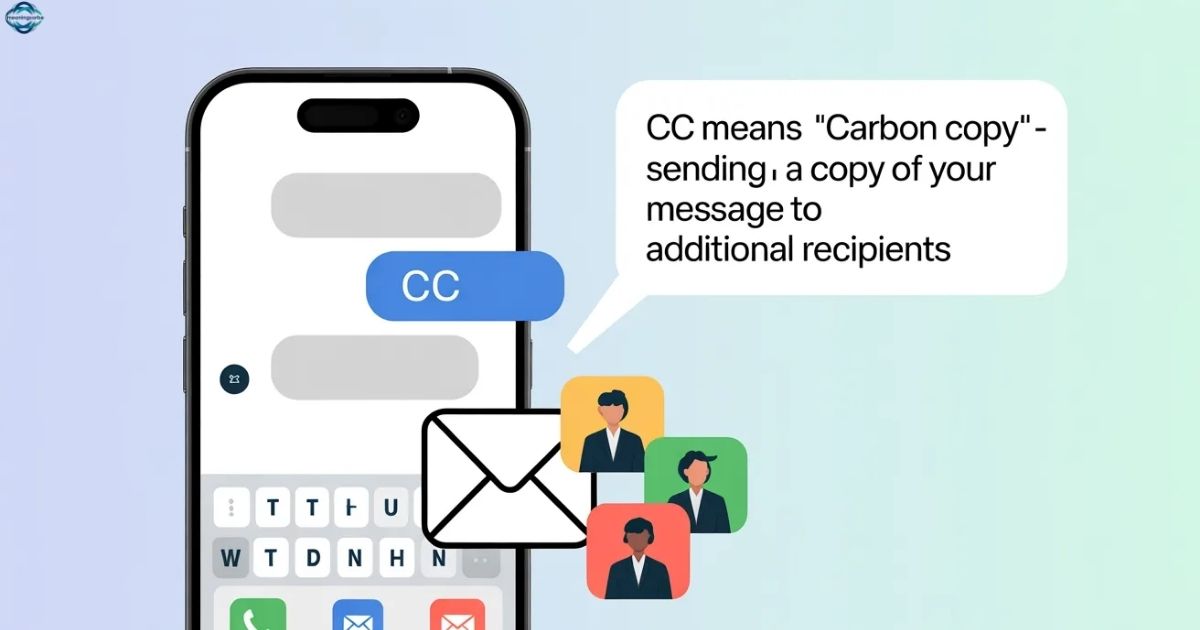
CC most commonly stands for “Carbon Copy.” In texting and online messaging, it means you are including another person in a conversation so they can see what’s being said even if they aren’t the main recipient.
Think of it as a digital way of saying, “Hey, I’m looping you in.” It’s transparent, direct, and keeps everyone on the same page.
Quick Answer: CC = Carbon Copy = including someone else in the message or conversation.
CC Meaning in Email vs Text Messages
CC as Carbon Copy (Email Origin)
The term “carbon copy” predates the internet entirely. Before computers, people used carbon paper placed beneath the original document while typing. The pressure would transfer the text onto the sheet below creating an exact duplicate. That duplicate was called the “carbon copy.”
When email was developed, this concept was carried over digitally. The CC field in an email allows senders to include additional recipients who should be informed but aren’t the primary audience. Everyone on the thread can see who was CC’d making it a transparent and accountable communication tool.
CC Meaning in Text Messages
In casual texting, CC carries the same spirit just more informally. If someone says “I’ll CC you,” they mean they’ll include you in an upcoming message or conversation thread.
You’ll see it used like this:
- “Can you CC Sarah when you send that update?”
- “I cc’d the whole team on that text chain.”
- “Just CC me so I know what’s going on.”
In text, CC signals inclusion, not action. The person being CC’d is expected to read and be aware not necessarily to respond.
Also read: What Does DPWM Mean in Text? Complete 2026 Guide
CC Meaning on Social Media
On platforms like Twitter/X, Instagram, and Facebook, CC takes on a slightly adapted role. Since these platforms don’t have a formal CC field, users simulate the concept by writing “CC: @username” in a post or comment to draw that person’s attention to specific content.
Examples:
- Instagram post: “Big announcement — CC: @manager @team”
- Twitter/X thread: “FYI everyone, CC: @johnsmith”
- Facebook comment: “You need to see this — CC: @Lisa”
Gen Z has also popularized a newer usage: CC = “Check Comments.” Seen often on Instagram and TikTok, it signals that the interesting content (a link, a joke, a resource) is in the comments section rather than the post itself.
CC Meaning in Video Content
On platforms like YouTube and TikTok, CC has a completely different meaning: Closed Captions.
Closed Captions are on-screen text that transcribes spoken dialogue, describes sound effects, and provides audio context for viewers who are deaf, hard of hearing, or simply watching without sound. CC in this sense is rooted in accessibility not messaging.
On TikTok especially, creators manually add “CC:” before their video text captions to signal accessibility, helping their content reach a wider audience. This is distinct from auto-generated subtitles and represents a creator’s conscious effort toward inclusivity.
How Context Changes the Meaning of CC
CC is one of the most context-dependent abbreviations in digital communication. Here’s a quick reference:
| Platform / Context | CC Meaning |
|---|---|
| Carbon Copy (include as secondary recipient) | |
| Text Messages | Looping someone into a conversation |
| Social Media (Instagram, Twitter) | Tag/notify someone; or “Check Comments” |
| TikTok / YouTube | Closed Captions |
| Technical / Medical | Cubic Centimeters |
| Gaming communities | Crowd Control |
Examples of CC in Real Conversations
Example 1 – Text Message
Priya: I’m sending the project update to the client today. Jake: Can you CC me on that? I want to stay in the loop. Priya: Of course, I’ll add you now.
Here, CC = carbon copy / looping someone in.
Example 2 – Social Media
Instagram caption: “Sharing the link to the new blog post — CC: @followers who asked last week!”
Here, CC = notifying specific people or directing attention.
Example 3 – Video Platform
TikTok caption: [CC: “Hey guys, welcome back to my channel! Today we’re cooking something easy…”]
Here, CC = Closed Captions for accessibility.
Is CC Considered Slang?
Not exactly. CC is better described as a communication abbreviation that has evolved across digital platforms. Its origins are professional (email culture), but its usage has become casual and widespread in everyday texting and social media.
It sits in a grey zone — more formal than most text slang (like “lol” or “tbh”), but casual enough to use in a WhatsApp group chat without raising eyebrows.
When Should You Use CC in Texting?
Use CC in a text message when:
- You want to include a third person in a conversation chain
- You’re forwarding information and want to flag who else is reading it
- You’re organizing a group update and want clarity on who’s looped in
- You’re in a professional setting and want to mirror email etiquette in messaging apps
Avoid it when the platform or audience may not recognize it — always read your room.
CC vs BCC — What’s the Difference?
| Feature | CC | BCC |
|---|---|---|
| Full Form | Carbon Copy | Blind Carbon Copy |
| Visibility | All recipients can see who’s CC’d | Recipients cannot see who’s BCC’d |
| Transparency | High | Hidden |
| Best Used For | Team updates, informational threads | Privacy-sensitive messages, large lists |
Why CC Is Still Popular Today
Despite being rooted in typewriter-era technology, CC has stayed relevant because it solves a real human need: keeping people informed without making them the center of a conversation.
In workplaces that blend email, Slack, Teams, and SMS, CC functions as a universal signal that travels across platforms. It’s short, universally understood in professional contexts, and instantly communicates intent.
Emotional Tone of CC in Texting
CC is largely neutral to informational in tone. It carries no emotional charge on its own it’s simply a logistical tool.
However, context can shift its emotional weight:
- Positive: “CC’d you so you don’t miss anything” feels inclusive and considerate
- Neutral: “Just cc-ing you FYI” — purely informational
- Tense: “CC’d the manager on this” can imply accountability or escalation
In professional settings, CC’ing a senior figure often adds subtle pressure to the thread. Among friends, it’s relaxed and friendly.
Common Mistakes People Make With CC
- Assuming CC always means the same thing — it doesn’t; always check the platform
- Replying to everyone when you’re CC’d — being CC’d means you’re informed, not obligated to respond
- CC’ing too many people — information overload is real; only include those who genuinely need to know
- Using CC when BCC is more appropriate — especially important when protecting email privacy
- Misreading CC as “Check Comments” in a work email — context really does matter here
How CC Reflects Digital Communication Evolution
CC is a perfect example of how language adapts across generations and platforms. What started as a mechanical printing term became an email convention, then a texting shorthand, then a social media signal, and now an accessibility marker on video platforms.
Each iteration preserved the core idea sharing information with someone beyond the primary recipient while molding itself to the needs of each new medium. That kind of adaptability is why CC has outlasted dozens of other abbreviations.
How to Respond When Someone Uses CC
If someone CC’s you on a message or email:
- You don’t need to reply unless you have something relevant to add
- A simple “Got it, thanks” is acceptable if acknowledgment feels appropriate
- If you’re CC’d on something that requires your action, clarify your role first
If someone says “CC me on that”:
- They want to be included as a secondary recipient in your next message
- Simply add their contact to the thread or forward a copy with them included
Does CC Have Negative Meaning?
CC itself is neutral but how it’s used can carry a negative tone. The most common negative association is “CC-ing the boss” as a power move: copying a manager on a message to signal escalation, create documentation, or apply pressure.
This is sometimes called “CC warfare” in professional settings and it’s generally considered poor communication etiquette when used to embarrass or pressure rather than genuinely inform.
Outside of this, CC carries no inherently negative meaning.
CC in Group Chats
In group chats on WhatsApp, iMessage, or Telegram, the concept of CC is somewhat built-in everyone in the group already sees the message. But people still use “CC: @name” to directly call someone’s attention within a large thread, mimicking the tagging feature found on social media.
It’s particularly useful in work group chats when a message is addressed to the group but one person needs to take specific note of it.
Featured Snippet Answer
What does CC mean in text?
CC stands for Carbon Copy in most text and messaging contexts. It means including another person in a message so they can see the conversation without being the primary recipient. In video platforms like TikTok and YouTube, CC means Closed Captions — on-screen text for accessibility. On social media, CC can also mean “Check Comments.” The meaning always depends on context.
FAQ’s
What is the full form of CC in texting?
CC stands for Carbon Copy it means copying someone into a message so they’re informed but not the main recipient.
Does CC mean the same thing in email and texting?
The core meaning is the same — including someone in a message — but email uses a formal CC field, while texting is more casual.
What does CC mean on TikTok?
On TikTok, CC stands for Closed Captions — text displayed on videos to make content accessible to viewers who are deaf or hard of hearing.
Is there a difference between CC and BCC?
Yes. CC shows all recipients who else received the message. BCC (Blind Carbon Copy) hides additional recipients from others on the thread.
Can CC have a negative meaning?
CC is neutral on its own, but CC’ing a supervisor on a message can imply escalation or pressure — sometimes called a “power move” in workplace communication.
Is CC considered outdated slang?
No. CC remains widely used across email, messaging apps, and social media in 2026 — it’s evolved with digital communication rather than fading out.
What does “CC me” mean in a text?
“CC me” means: include me in that message or conversation so I can see what’s being discussed.
What does CC mean on Instagram?
On Instagram, CC typically means tagging someone for visibility — similar to carbon copy. Gen Z also uses it to mean “Check Comments” when pointing followers to content in the comment section.
Conclusion — Final Thoughts
CC is one of those abbreviations that seems simple on the surface but carries more nuance than most people expect. Whether you encounter it in a professional email, a group chat, a TikTok caption, or an Instagram post, the underlying idea is always the same: someone wants to make sure the right people are in the loop.
Understanding CC means understanding intent, not just definition. Once you know the platform and the context, the meaning becomes obvious and you’ll start noticing it everywhere.
Next time someone says “CC me on that,” you’ll know exactly what to do. And next time you see [CC] on a YouTube video, you’ll know that’s got nothing to do with email it’s about making content accessible to everyone.

Elijah Lucas is the founder and creative mind behind this platform, dedicated to exploring the deeper meanings behind words, symbols, and ideas. With a passion for knowledge and a curiosity for understanding, he strives to provide clear, insightful, and engaging content for readers.