
Text messaging has completely changed the way people communicate. Shortcuts, abbreviations, and internet slang are now a normal part of daily conversations. Whether you’re chatting with friends, sending work messages, or scrolling through social media, you’ve probably come across many acronyms that save time and make conversations faster.
One abbreviation that often confuses people is LYK. If you’ve received a text saying “I’ll lyk later” or “lyk what happens,” you may have wondered what it actually means.
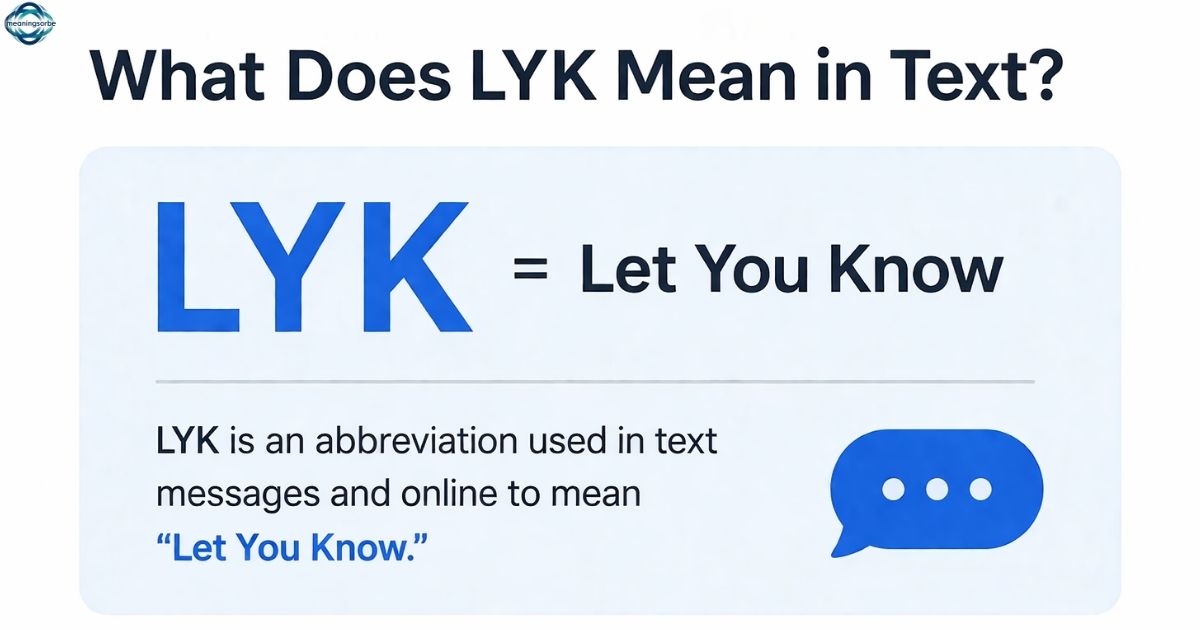
In simple terms, LYK usually means “Let You Know.” It’s commonly used in texting, online chats, emails, and social media messages to tell someone that you will update them with information later.
This guide explains everything you need to know about LYK meaning in text, how to use it properly, examples, differences from similar terms, and why it remains popular.
Meaning of LYK in Text
Exact Definition
LYK stands for “Let You Know.”
It is used when someone wants to tell another person that they will provide information, confirmation, or an update later.
For example:
- “I’ll lyk when I arrive.”
- “Lyk if the meeting gets canceled.”
- “I’ll lyk once I talk to him.”
In each case, the person is promising to share information when they have it.
Also read: What Does PDA Mean in Text? Full Meaning Explained Simply (2026 Guide)
How People Understand LYK
Most people instantly understand LYK because it has become common in digital communication.
When someone says “I’ll lyk,” they usually mean:
- They don’t have the answer yet
- They need more time
- They will provide an update later
- They are acknowledging your request
It often signals courtesy and keeps communication open.
Why People Use LYK
It Saves Time
Typing full phrases can feel unnecessary in quick conversations.
Instead of writing:
“I will let you know after I finish checking.”
People simply write:
“I’ll lyk.”
This makes texting faster and easier.
Fits Digital Culture
Modern communication values speed and convenience.
Just like people use:
- LOL
- BRB
- FYI
- IMO
They also use LYK because it fits naturally into today’s fast-paced messaging style.
Friendly & Polite Tone
LYK sounds casual but still respectful.
It shows the other person that:
- You received their message
- You care enough to reply
- You plan to respond later
This helps avoid sounding dismissive.
Shows Responsibility
Using LYK often signals accountability.
For example:
“Lyk once I confirm with the manager.”
This tells the other person you’re taking responsibility for following up.
How to Use LYK in Sentences
Casual Examples
Casual conversations are where LYK appears most often.
Examples:
- “I’ll lyk if I’m free tonight.”
- “Lyk when you get home.”
- “I’ll lyk what happens.”
- “Lyk if they call.”
- “I’ll lyk after class.”
These are simple and natural.
Friendly Examples
When chatting with friends, LYK keeps things relaxed.
Examples:
- “I’ll lyk what movie we pick.”
- “Lyk if you want to join us.”
- “I’ll lyk when we leave.”
- “Lyk if you need help.”
- “I’ll lyk after I talk to Sarah.”
It keeps communication open without sounding formal.
Professional Examples
Although less common, LYK can work in informal professional settings.
Examples:
- “I’ll lyk once the report is ready.”
- “Lyk if there are any changes.”
- “I’ll lyk after discussing with the team.”
- “Please lyk your availability.”
- “I’ll lyk once I receive confirmation.”
For highly formal communication, however, writing the full phrase is usually better.
Difference Between LYK and LMK
Many people confuse LYK and LMK.
Quick Comparison
LYK = Let You Know
Used when you will provide information.
Example:
“I’ll lyk tomorrow.”
LMK = Let Me Know
Used when you want someone else to provide information.
Example:
“LMK if you’re available.”
The difference is all about who gives the update.
When Should You Use LYK?
Use LYK when:
- You need time before answering
- You’re waiting for confirmation
- You plan to update someone later
- You want to acknowledge a request quickly
- You’re texting casually
Good situations:
- Making plans
- Scheduling
- Following up
- Sending updates
Example:
“Still waiting for the reply. I’ll lyk soon.”
When You Should NOT Use LYK
Avoid LYK in:
Formal Emails
Instead of:
“I’ll lyk soon.”
Write:
“I will inform you shortly.”
Academic Writing
Abbreviations can look unprofessional.
Official Business Documents
Professional communication usually requires complete wording.
Conversations with People Unfamiliar with Text Slang
Older adults or formal contacts may not understand it.
Synonyms of LYK
There are many alternatives depending on the context.
Casual Alternatives
- I’ll tell you
- I’ll update you
- I’ll text you
- I’ll message you
- I’ll get back to you
Examples:
“I’ll update you later.”
Professional Alternatives
- I will inform you
- I will provide an update
- I will notify you
- I will follow up
- I will confirm shortly
These sound polished and professional.
Real Conversation Examples
Friends
Alex: Are we still meeting tonight?
Jake: Not sure yet, I’ll lyk after work.
School
Student 1: Did the teacher postpone the test?
Student 2: I’ll lyk after I ask.
Work
Manager: Has the client approved the design?
Employee: I’ll lyk as soon as they respond.
Family
Mom: What time will you be home?
Son: Not sure, I’ll lyk later.
Variations of LYK
People often modify LYK for different situations.
Common variations:
I’ll lyk – Most common
Lyk asap – Let you know as soon as possible
Will lyk – Slightly more direct
Lykk – Informal playful spelling
Lyk soon – Promise of quick update
These variations depend on texting style.
Popularity of LYK Across Ages
Different age groups use LYK differently.
Teenagers (13–19)
Very common
Used naturally in daily texting
Example:
“Lyk when I’m there.”
Young Adults (20–35)
Frequently used
Common in texting and group chats
Adults (35–50)
Moderately used
More common among those comfortable with digital slang
Older Adults (50+)
Less common
Many prefer writing full phrases
Linguistic Insight
LYK reflects a broader trend in digital language called abbreviation compression.
This happens when people shorten common phrases for speed.
Examples:
- TY = Thank You
- IDC = I Don’t Care
- IMO = In My Opinion
- LYK = Let You Know
These shortcuts emerge because texting favors efficiency. Interestingly, context usually makes the meaning obvious even without full words.
Extra Example Sentences
Here are more examples of LYK in action:
- I’ll lyk after dinner.
- Lyk if the tickets are available.
- I’ll lyk when I finish.
- Can’t confirm yet, but I’ll lyk.
- Lyk if you need anything.
- I’ll lyk tomorrow morning.
- Lyk once you decide.
- I’ll lyk after the interview.
- Lyk if there’s a problem.
- I’ll lyk when they respond.
These examples show how flexible the abbreviation is.
Does LYK Ever Mean LIKE?
This is a common question. Sometimes, yes. In rare cases, people may type lyk as a shortened or misspelled version of “like.”
Example:
“That was lyk so funny.”
Here, it means like, not “let you know.” The meaning depends entirely on context. If the sentence involves future updates, it means Let You Know. If it fits as a filler word, it probably means like.
Expert Breakdown (E-E-A-T Style)
Experience
Digital communication experts observe that abbreviations like LYK are widely used in casual texting.
Expertise
Language specialists classify LYK as an internet acronym designed for efficiency.
Authoritativeness
Major texting slang databases consistently define LYK as Let You Know.
Trustworthiness
Context determines meaning, but in most modern messaging situations, LYK reliably means Let You Know.
FAQ’s
What does LYK stand for?
LYK stands for Let You Know.
Is LYK formal?
No. It is mostly casual and informal.
Can I use LYK at work?
Yes, but only in relaxed workplace chats. Avoid it in formal emails.
Is LYK the same as LMK?
No.
LYK = Let You Know
LMK = Let Me Know
Does everyone understand LYK?
Not always. Some people unfamiliar with texting slang may not recognize it.
Is LYK still popular in 2025?
Yes. It remains common in texting and online messaging.
Conclusion
So, what does LYK mean in text? It most commonly means “Let You Know.” It’s a simple, efficient abbreviation used to promise future updates, confirm follow-ups, and keep conversations moving smoothly.
People use it because it:
- Saves time
- Sounds friendly
- Fits modern digital communication
- Shows responsibility
While it works perfectly in casual texting and informal chats, it’s best to avoid it in highly formal communication. Now, the next time someone texts “I’ll lyk,” you’ll know exactly what they mean.

Elijah Lucas is the founder and creative mind behind this platform, dedicated to exploring the deeper meanings behind words, symbols, and ideas. With a passion for knowledge and a curiosity for understanding, he strives to provide clear, insightful, and engaging content for readers.